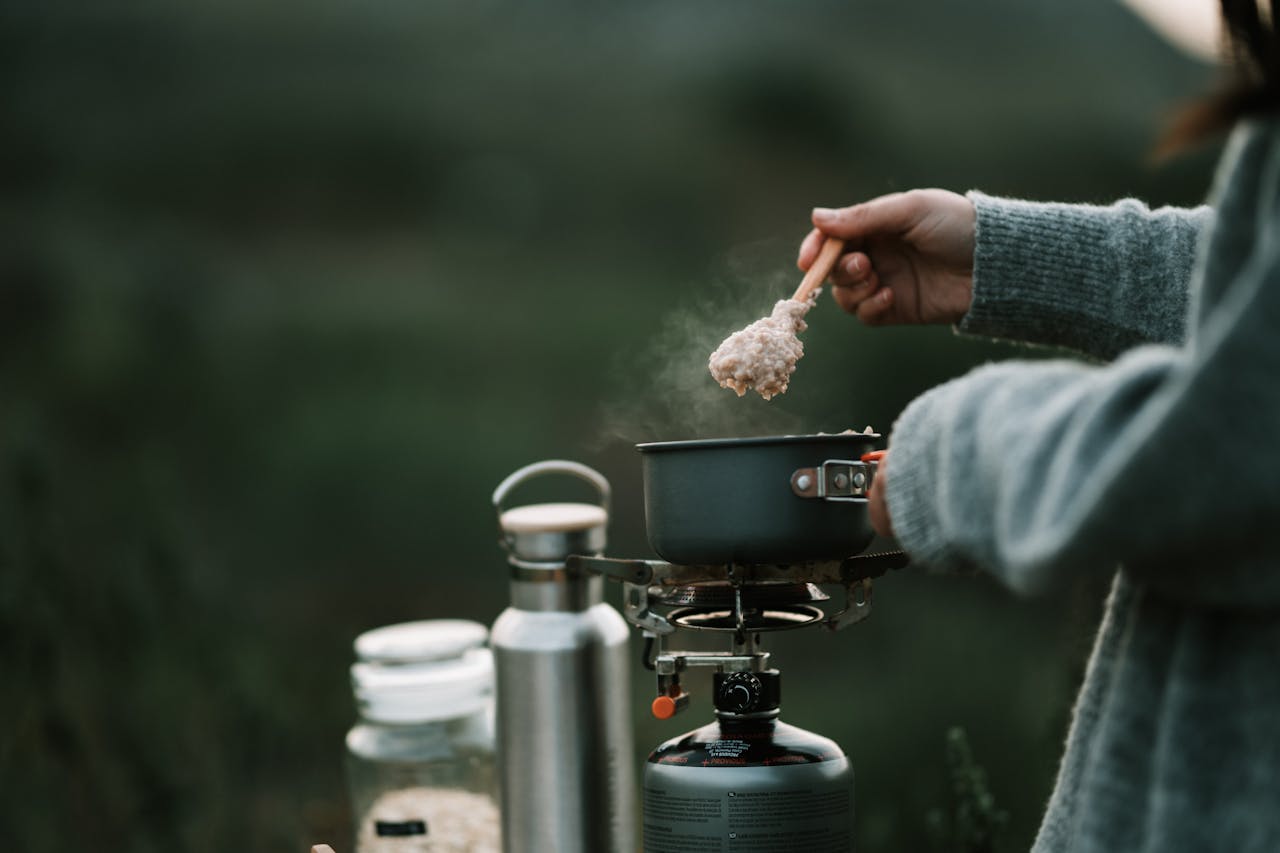
Whether you’re car camping or going for a big hike in the backcountry, one thing’s for sure: You’ll need to eat! When you are camping, your cooking ability and the quality of your food can still be premium with the ideal camping kitchen setup.
If you are car camping, you’ll have the luxury of a bunch of big cooking equipment that can easily be hauled in. But if you’re backpacking, it wouldn’t be convenient to carry the entire cooking setup. Instead, you need to be economical and limit it to the individual necessities like a stove, lightweight cooking gear, mugs, dishwashing supplies, utensils, and food storage.
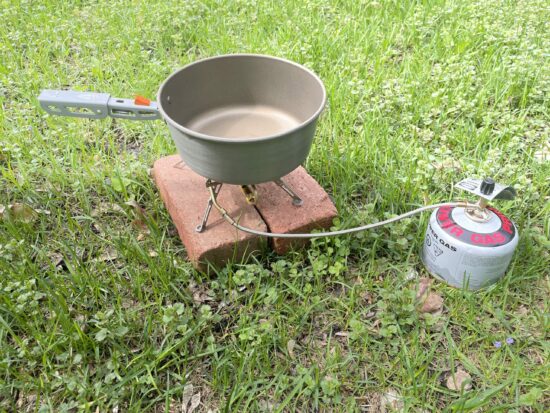
You will need lightweight gear and pots. A loaded backpacking bag should not be more than 20% of your body weight, so you should choose your items wisely. That doesn’t mean you have to compromise, though. You can get some really great quality gear nowadays!
The perfect camp kitchen setup should have three areas, and the right equipment to go along with them:
- A cooking area
- A place for prep work and cleaning
- An area to eat
To organize these three stations, here are some things you can consider.
Quick Comparison: Car Camping vs. Backpacking Kitchen Setup
Feature | Car Camping | Backpacking |
Stove Type | Two-burner propane stove | Single-burner canister stove |
Cookware | Multiple pots and pans and cast iron | One lightweight pot or titanium set |
Tableware | Full-size plates and bowls | Collapsible or nested bowls and cups |
Food Storage | Hard cooler and bear canister | Dry bags and bear canister and hang bag |
Weight Concern | Low priority | High priority (max 20% body weight) |
Prep Surface | Two camp tables ideal | Flat rocks and tarp or top of pack |
Dishwashing | Collapsible tubs and water source | Minimal water and biodegradable soap |
Fuel | Large propane tanks | Small threaded canisters |
Comfort Level | High | Streamlined but totally doable |
How to Think About Your Camping Kitchen
Portability
If you are car camping, weight matters way less, and you can indulge in bigger pots, pans, and cookware. You can even bring a relatively large stove capable of cooking a pretty large meal at one time. However, if you are backpacking, bikepacking, canoeing, or anything else where space is limited, the weight of your items is paramount, so take only what you need and make sure all your items are lightweight.
It is worth noting that bikepacking and canoe camping sit somewhere in between car camping and backpacking in terms of what you can realistically bring. Canoe campers, for instance, often have more room than backpackers but still need to be smart about weight distribution across the vessel. If you are paddling into a remote lake for a few nights, a small two-burner stove and a solid cookware set can be totally manageable without going overboard.
Prep and Cleanup Space
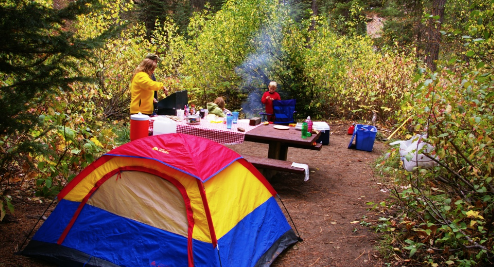
If your particular campsite allows for it, it is recommended to have a two-table kitchen setup, while simple camping kitchens mostly have just one. Two surfaces are a gamechanger as far as convenience goes. Admittedly, you are probably only going to have this kind of setup if you are at a well-maintained campground, such as in a state or county park.
If you are in the backcountry, though, two tables is probably out of the question. You will be lucky to find two flat rocks, which, by the way, is not a bad way to work!
Organization
If your kitchen setup has some sort of camp tool box or closable container, or webbed lining where you can keep your pots and pans, and utensils, it will reduce clutter and keep everything in sight. A dedicated camp kitchen organizer or roll-up utensil bag can make a surprising difference, especially on longer trips where gear tends to migrate around camp.
The longer you’re gone, the more food you will need to pack obviously, taking up more space. Backpackers like taking dehydrated meals as they take up less space and are lightweight, whether homemade or store-bought. A backpacker should not carry weight equal to more than 20% of their total body weight.
While most car campers have the luxury of a two-burner stove and multiple pots and pans, backpackers have to carry the barest minimum. They can also carry a cooler with plenty of food, reducing the chances that food will need to be rationed.
Camp Kitchen Essentials
Regardless of what type of camping you are doing, there are a few go-to items that you will want to be sure to have in hand.
Camping Stove
Backpackers will carry a one-burner canister stove while those who are car camping can easily carry a two-burner stove that allows for multiple dishes or group meals. Make sure to always carry an extra lighter or matches in case of emergencies.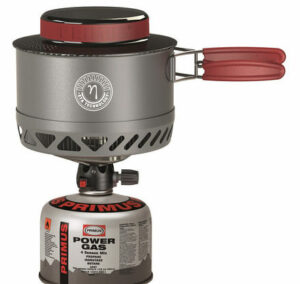
We did an entire piece on Camping Stoves, but will summarize a couple top picks for you here:
The Coleman Classic Propane Camping Stove is an excellent two-burner stove for car campers, while the MSR Pocket Rocket is a great canister stove overall for performance, durability, and weight, and is great for those who are hiking in to their campsite. Another solid option worth mentioning is the Jetboil Flash, which combines a burner and cooking cup into one incredibly efficient system, making it one of the fastest ways to boil water on the trail. It is a favorite among thru-hikers and weekend backpackers alike.
Outdoor Tableware
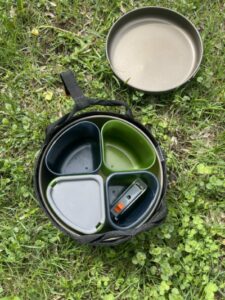
It is always nice to use recyclable or reusable eco-friendly tableware, so you can look out for lightweight plates and bowls made from sustainable materials. For backpackers, always look for collapsible bowls or cups that will save you some pack space. In fact, we like ones that can be tucked-in to other camp necessities, like a cooking pot. See the photo for what we mean.
Camping Utensils
A good chopping knife, cutting board, peeler, spatula, can opener, basically everything you use on a daily basis at home, you’ll need while camping. Keep it lightweight but durable, and check out all the silicone utensils available. A spork, which is a spoon and fork combination, is a backpacker favorite and cuts down on the number of utensils you need to carry significantly. Many come with a built-in knife blade as well, making them a true all-in-one tool.
Camping Cookware
Depending on what you intend to cook, you’ll need a pan or pot to cook in. If you can afford the space and weight, a pot would be a better choice, as you can also fry in a pot and boil water for coffee. The fact is you don’t need multiple pots and pans if you are trying to be economical on space. Buy one, and buy well.
If you’re cooking over an open flame like a campfire, car campers can think about a cast-iron skillet, as they are versatile and can last decades. Titanium and hard-anodized aluminum cookware are excellent choices for backpackers since they offer great heat distribution at a fraction of the weight of traditional pots.
Coffee Setup
For many campers, a morning cup of coffee is non-negotiable, and rightfully so. Car campers have plenty of options here, from a classic percolator over the fire to a portable pour-over dripper that sits right on top of a mug. Backpackers tend to love instant coffee packets or single-serve pour-over bags that weigh almost nothing and take up virtually no space. A small, lightweight French press designed for camping is another popular option if you want something with a little more flavor payoff. Whatever your method, do not underestimate how much a good cup of coffee can boost morale on a cold morning in the woods.
Dish-Washing Outdoors
It is easy enough to do your dishes if you have a water source, but if not, you can use a collapsible tub or portable sink. You’ll also need dish soap, sponges, and garbage bags to pack out your trash. If you are intending to do your dishes in a water source like a lake or river, be sure to use eco-friendly soap that is natural and biodegradable.
It is important to keep your camp clean, and to wash dishes immediately. Dirty dishes attract absolutely everything to your campsite — ants, birds, squirrels, mice, and even bears.
Water Filtration
This one does not always make it onto camp kitchen lists, but it absolutely should. Whether you are car camping near a stream or backpacking through the wilderness, having a reliable way to filter or purify water can be a true lifesaver and will reduce how much water you need to pack in. The Sawyer Squeeze and LifeStraw are both excellent, lightweight options for backpackers. Car campers might prefer a gravity filter that can process larger volumes of water without any effort. Always know your water source before you go and plan accordingly.
How To Organize Your Camp Kitchen
Now that you’ve got all the items necessary for your camp kitchen, you’ll have to organize your stuff. Keep your kitchen setup at least 10 ft from the campsite (to keep animals away, as they love your scraps) and also try to shelter your cooking area from the wind.
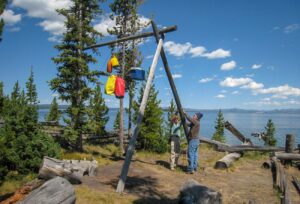
In some areas, you may want to hang your food bags on a limb or frame. The classic bear hang involves tossing a rope over a high branch and suspending your food bag well above the ground and away from the trunk of the tree. In areas with high bear activity, a certified bear canister may be required rather than just recommended.
Try to keep the kitchen setup at an angle where you can see everything around you. If you have tables, set them up a short distance from each other so that the prep area can easily be reached from the cooking area. Your eating area can be located wherever you like. A spot with a view would be nice!
If you don’t have tables, try using your coolers or anything to elevate the food off the ground, or backpackers can use a tarp. Accidentally leaving food on the ground is not a good idea as it can attract animals and bugs.
Shelter your tables, gear, and food by using a pop-up shelter or tarp if you are expecting inclement weather.
Keep your trash bag near the dishwashing area away from the campsite. In some areas, trash needs to be hung from a tree, or stashed in bear-proof lockers, so check if you are entering some areas. If backpacking, never store your trash or food in your tent, even if you have a larger tent. Animals may smell the food, and not knowing you are in the tent, attempt to get at it which can be a bit terrifying.
Using Your Camp Kitchen
Lay out all the ingredients for the meal in your prep area, and set up your wash station so you can wash your cookware quickly for reuse.
Once you’ve cooked your meal in the cooking area, you’ll need to do your dishes. If you have the luxury of buckets, fill one with hot water and soap, then soak and clean the dishes. Rinse them off with cold water and pat dry before you stash them away.
The smaller the better when it comes to camp stoves.
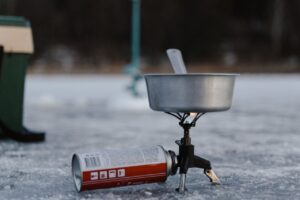
Be sure not to throw dirty dishwater into the ground near your camping area, as the scent can attract animals that you don’t want to encounter! Throw any scraps of food you have left over far, FAR away from your campsite.
Store all your food in bear-proof containers to keep away any unwanted visitors during the night.
How Much Food Should I Take Camping?
There are a few variables involved when trying to determine how much food to bring along camping.
Ideally, 2,500 to 3,000 calories a day is needed, depending on your metabolism, age, and activity levels. The more you intend to hike, the more calories you’ll need. This is roughly one and a half to two and a half pounds of food a day, so factor that into your pack weight.
A key variable, of course, is if you will be finding your own food along the way, picking berries, catching fish, and son on. If you will be in a fish-rich area and are a proficient fisherperson, bringing a fillet knife might allow you to pack less food. A great destination for this kind of trip is the Boundary Waters Canoe Area Wilderness (BWCAW) in northern Minnesota, which is legendary for its walleye and northern pike fishing. If you are a capable angler, you can genuinely supplement your food supply and lighten your pack in a beautiful and remote setting.
If you’re going on a three-day backpacking trip, you’ll need about six to seven pounds of food. Try to take foods that will help reach your desired calorie count so you will stay energetic. Always plan your meals beforehand and try to pack your comfort foods which will be much appreciated after a long day hiking!
Freeze-dried, dehydrated, ready-made meals are all perfect for when you are not in the mood to whip up a full-blown dinner. Also, if you are around a place with no water, you’ll need to plan your water rations to include what you’ll need to cook. 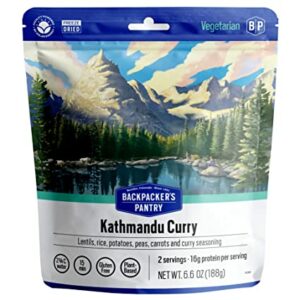
Another thing to keep in mind is the amount of fuel you will need to make all the meals in your meal plan. Some dishes take longer to cook than others so use your fuel wisely.
Test recipes at home before experimenting out in the backcountry. Sometimes when you try a new recipe, it does not turn out as expected which could lead to a waste of ingredients, time, space, and fuel.
If you have babies or toddlers accompanying you on this camping trip, make sure to have snacks and meals they enjoy at home so that you do not have to deal with pickiness or fussiness while enjoying the wilderness.
Final Thoughts
Going camping doesn’t mean you need to live on granola bars or dehydrated food. With the ideal camp kitchen setup, you can enjoy your home comforts while being nestled in the great outdoors!
Always remember that our responsibility as campers means we need to keep our food away from animals. Bears that are too used to humans often end up getting culled. Have fun and happy camping!
Frequently Asked Questions
What is the most important piece of camp kitchen gear?
A reliable stove is arguably the single most important piece of kit. Without it, you are limited to cold food or whatever you can cook over an open fire, which is not always an option. Everything else can be improvised to some degree, but a stove gives you real cooking flexibility regardless of conditions.
How do I keep food cold while backpacking?
This is one of the trickiest parts of backpacking meal planning. The honest answer is that keeping food cold for more than a day or two in the backcountry is difficult without a cooler. Most backpackers solve this by focusing on shelf-stable foods like dehydrated meals, nut butters, hard cheeses, cured meats, and dried fruit. If you are car camping, a quality cooler packed with block ice rather than cubed ice will keep things cold significantly longer.
Is it safe to cook inside a tent vestibule?
No, and this one is really important. Cooking inside a tent or even under a rain fly vestibule creates two serious risks: carbon monoxide poisoning from stove fumes and the very real possibility of melting or igniting your tent. Always cook well away from your sleeping area and in open air with good ventilation.
What is Leave No Trace, and how does it apply to camp cooking?
Leave No Trace is a set of outdoor ethics designed to minimize human impact on nature. When it comes to camp cooking, it means packing out all trash including food scraps, using biodegradable soap at least 200 feet from any water source, dispersing dishwater away from camp and water sources, and never leaving food or crumbs that could attract wildlife.
Can I use a campfire instead of a camp stove?
Yes, but with some caveats. Open fires are not permitted everywhere, so always check local regulations before you plan on cooking over one. Campfire cooking is also less predictable and harder to control than a stove, and it produces a lot of smoke. That said, campfire cooking can be incredibly rewarding and is a great option for car campers who have the time and the right conditions.
How do I dispose of grease and cooking oil while camping?
Never pour grease or cooking oil on the ground or into a water source. The best approach is to let it cool, then soak it up with a paper towel and pack it out in a sealed plastic bag with the rest of your trash. Some experienced campers use a small, sealed container specifically for grease disposal.
What should I do if a bear enters my camp?
Stay calm, make yourself appear large, speak in a firm and loud voice, and back away slowly. Never run. If you have bear spray, have it accessible and know how to use it before your trip, not during the encounter. The best strategy is prevention: store all food, scented items, and trash properly so that bears are never attracted to your camp in the first place.
Are canister stoves allowed in all backcountry areas?
Most areas allow canister stoves, especially when open fires are restricted. However, some extremely sensitive wilderness areas, alpine zones above the treeline, or areas with high fire danger may have additional restrictions. Always check with the land management agency for the specific area you are visiting before your trip.